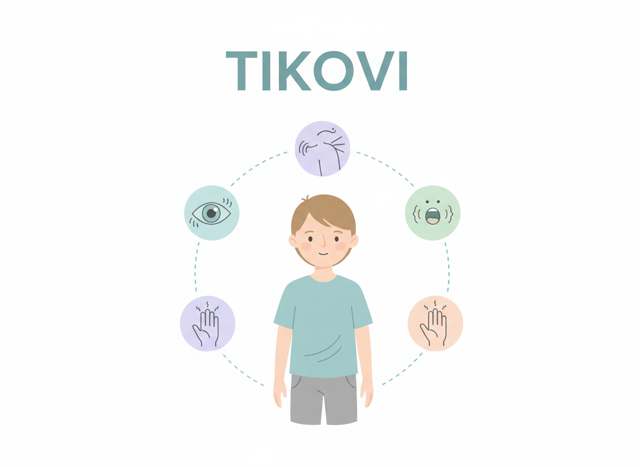
Tics in Children and Adolescents: What They Are, Why They Happen, and When to Seek Help
Learn what tics are, what motor and vocal tics look like, the difference between transient and chronic tic disorders, and when a professional assessment is recommended.
Tics are relatively common in childhood and adolescence and can be very worrying for parents, especially when they appear suddenly or are noticed at school. The good news is that transient tics are often benign and have a good prognosis, but it is important to know when to monitor and when to seek a more detailed assessment.
This article is for informational purposes and cannot replace an individual clinical evaluation.
What are tics?
Tics are involuntary, sudden, rapid, repetitive, non-rhythmic motor movements and/or vocalizations. They are typically brief, may occur in bursts, and appear to have no clear purpose.
The literature often highlights additional features of tics:
- a tic can sometimes be suppressed for a short time
- suppression may cause discomfort or a sensory urge before the tic
- performing the tic is often followed by short-term relief
- tics can be highly suggestible, meaning they may increase when talked about or when the child becomes more aware of them
Important: in younger children, the sensory urge may be absent and is more commonly reported after around age 10.
What does a tic cycle look like?
For many children and adolescents, a tic can follow a repeating pattern:
- an unpleasant premonitory sensation (like an internal itch)
- rising tension
- the tic occurs
- brief relief (seconds to minutes)
- the urge returns
This is one reason tics may seem semi-voluntary: a child may be able to suppress them briefly, but often at the cost of increasing tension.
Types of tics (motor vs. vocal; simple vs. complex)
Tics can be classified:
- by manifestation: motor or vocal
- by complexity: simple or complex
Simple motor tics
Examples include:
- eye blinking
- facial grimacing
- head jerking
- shoulder shrugging
Complex motor tics
These may look purposeful or elaborated, for example:
- running or hopping movements
- complex grasping or movement patterns
- self-hitting (less common, but clinically important)
Special forms:
- echopraxia (repeating other people’s movements)
- copropraxia (complex obscene gestures)
Vocal tics
Vocal tics can range from simple sounds to more complex vocalizations.
Examples of simple vocal tics:
- throat clearing
- sighing
- sniffing
- squeaking
Complex vocal tics:
- shouting
- whistling
Special forms:
- coprolalia (uttering obscene words)
- palilalia (repeating one’s own words)
- echolalia (repeating other people’s words)
Why do tics get worse with stress or excitement?
Tics typically increase:
- during stress and tense situations
- during excitement
- with boredom
They often decrease or disappear during sleep, though not always. Tics can fluctuate, changing over time in intensity and in where they occur in the body.
Tics may be associated with:
- shame
- lower self-esteem
- social isolation
That is why it is important not to focus only on the movement itself, but also on how the child experiences it.
Which tic-related diagnoses exist? (transient, chronic, Tourette)
According to DSM-5, three main entities are described:
- Provisional (transient) tic disorder
- motor and/or vocal tics
- duration less than 1 year
- Persistent (chronic) motor or vocal tic disorder
- motor or vocal tics, but not both
- duration more than 1 year
- Tourette syndrome
- multiple motor tics plus at least one vocal tic, not necessarily at the same time
- duration more than 1 year
In practice, clinicians often describe a tic disorder spectrum, ranging from transient tics to Tourette syndrome.
When do tics usually start?
- transient tics: typically between ages 3 and 10
- Tourette syndrome: often begins around age 6 with motor tics; the full clinical picture commonly develops around age 11, when vocal tics may appear
How common are tics?
- transient tics: 4 to 24% of school-age children
- chronic tics: about 1 to 4%
- Tourette syndrome: reported in children and adolescents from 1 in 100 to 1 in 10,000
Tics are more common in boys than in girls.
What does a professional assessment involve?
Assessment is based on a detailed history and collateral history, because children may sometimes minimize symptoms, focusing on:
- type of tic (motor/vocal; simple/complex)
- number, intensity, and frequency
- fluctuations and changes in localization
- whether the child can suppress the tic and what happens when they do
- interference with functioning (school, relationships, self-confidence)
- triggers and situational context
- medication use (e.g., methylphenidate)
Depending on the clinical picture and specialist judgment, additional evaluations may be recommended:
- pediatric and neurological examination
- laboratory workup
- EEG when indicated
- monitoring antistreptolysin titer when indicated (e.g., if PANDAS is suspected)
- psychological assessment and attention/functioning evaluation
- symptom rating scales (e.g., Yale tic scales)
What can look like tics? (differential diagnosis)
It is important to differentiate tics from other conditions, such as:
- motor stereotypies
- compulsions (OCD)
- mannerisms
- epileptic phenomena (e.g., absence seizures)
- neurological conditions (e.g., chorea, facial spasm)
- conversion symptoms
Comorbidities: what often occurs alongside tics?
Tics frequently co-occur with:
- ADHD, often reported in up to about half of cases
- OCD, reported up to 44%
- anxiety disorders
- behavioral disorders
- depression
That is why it is important to assess the whole picture: sometimes a child suffers more from anxiety, ADHD, or OCD than from the tics themselves.
Treatment: what helps with tics?
Treatment should be comprehensive (multimodal) and flexible. Depending on severity and duration, options may include:
- psychoeducation (child and parents)
- supportive treatment (e.g., play therapy)
- behavioral approaches (e.g., habit reversal therapy)
- relaxation techniques
- cognitive therapy
- psychodynamic approach, especially in mild to moderate forms
- parent work and, when needed, family therapy
- medication, not as first-line treatment, but considered for severe tics and/or significant comorbidity
The goal of treatment is usually not complete disappearance of tics, but making them more manageable and improving daily functioning.
Guidance for parents and teachers
- Tics are not intentional, and it is important to explain this clearly to both the child and the environment.
- Avoid excessive attention to the tics, because constant commenting can increase symptoms.
- Treat the child as normally as possible, with a supportive approach.
- Do not wait too long if there is distress, social withdrawal, or functional impairment.
- Consider stressors and family context, because transient tics often have stress in the background.
When should you seek professional help?
An assessment is recommended if:
- tics last longer than a few weeks and are increasing
- tics persist longer than 12 months
- both motor and vocal tics are present
- the child experiences significant distress, shame, school avoidance, or peer difficulties
- there are signs of comorbidity (ADHD, OCD, anxiety, depression)
- there are self-injurious tics or risky behaviors
When should you book an appointment?
If you have noticed tics in your child or adolescent and you are unsure whether this is a transient phenomenon or something that requires a structured assessment, it can be helpful to schedule a professional evaluation and agree on a monitoring plan.
At Poliklinika Golden Mind (Zagreb), we assess tics and common comorbidities (ADHD, OCD, anxiety) and can recommend psychotherapy and other supportive approaches when indicated.
FAQ
Should transient tics be treated?
Views differ in the literature, but in practice an initial evaluation, monitoring, and parent guidance are often recommended, because at the beginning it is not always clear whether symptoms will resolve quickly or persist.
Are tics a sign of bad parenting?
No. Tics are not a choice, and a child cannot fully control them.
What is PANDAS?
PANDAS is a pediatric autoimmune neuropsychiatric disorder associated with streptococcal infection, classically linked with OCD and tics. Evaluation and workup should be done in collaboration with a pediatrician or neuropediatrician and a child psychiatrist.